post

Do you buy advertising like you buy gum?

Samantha: It was an impulse purchase!
Carrie: Gum is an impulse purchase… this is more than gum!

Samantha trying to justify her cosmetic chemical peel decision
as an impulse purchase she has on Sex and The City.

Carrie has perfectly expressed the reasonable expectation of an “impulse purchase.” Much the same can be said about impulse purchases with your business’s marketing – they should be strictly reserved for stands in grocery shopping lines.

There are many scams, tricks, sneaky tactics, dodgy offers, (you get it…), out there – victims often being new businesses. “If it sounds too good to be true, it probably is”.

The issue you face when making an impulse purchase is that you aren’t efficiently thinking about the resulting consequences of this decision, resulting in actions that aren’t working towards the needs of your business as well as wasting a huge amount of money… You need to ask yourself every time, “Is this the highest and best use of my money?”

Stoking your impulses

Sales reps use a lot of tactics in order to sell you something. Some of the common ones include:

Offering “free” editorial with your print Ad purchase, therefore making the “package” more appealing. It can be appealing to have the opportunity to write more about your business, but be warned – the publication usually will have no obligation to print your editorial exactly as you have supplied and may change if they wish. You haven’t paid for the editorial space so it leaves the door of your business wide open.

The allure of “distress rates” which are the rates that are discounted at the 11th hour just before the publication needs to go to print, whereby spaces need to be filled and therefore prices cut. The main issue is you will most likely not have sufficient time to produce a well-structured message and attractive Ad, therefore you are really just placing an Ad for the sake of it.

With broadcast media, (i.e. radio and TV), bundling a schedule with a lot of bonuses. Bonus spots are not paid for by you; therefore the station has no obligation to actually run them. They are the push up bras of the broadcasting world – FILLERS that are all for show – used to make things look bigger, better, and more attractive but when it’s time for action, they seem to disappear… Also, bonus spots cannot be scheduled to the time slots/shows as paid spots can – they can play at any time and therefore you aren’t getting the consistency and repetition required for effective advertising.

Advising you “your competitors are doing it.” This is an all time pet hate tactic used by reps which comes back to the old adage your Mum would have said to you, “If little Jimmy was going to jump off a bridge, would you?” Just because your competitors are, doesn’t mean you should or have to. And being in the same places as your competitors can often work AGAINST you.

If you don’t have an effective marketing message and strategy the above sales rep tactics will cause you to make impulse purchases. The result being, more wasted marketing dollars.

So, keep impulse purchases for the grocery store and out of your business – even if it does sound amazing, as chances are, your impulses will stifle your business’s growth.

 ABOUT THE AUTHOR:
Sarah Ripley, Wizard of Ads Australia
Sarah is a young marketer who attempts to challenge the “grey hair syndrome” where you need to be middle-aged and balding to know how to market a business.
post

Five marketing mistakes you can’t afford

That competitor across the street is plotting to steal your customers right now. Could your marketing be making it easy for them? Typically, it’s not big things that lose customers; they’re too obvious. Costly mistakes are usually the little ones, easily overlooked in your daily buzz of doing business.

How clean are your trays?

Customers see things you don’t. Dirty tray-tables left airline passengers wondering about engine maintenance. “If they can’t get the little things right, what about the big things?” surveyed passengers told Tom Peters and Robert H. Waterman, Jr. in their 1982 book, In Search of Excellence.

While some of the so-called “excellent” companies have gone by the wayside, their principles of excellence still apply. Learning from the customer, for example, helped expose these marketing mistakes:

These little things will cost you customers

1. Stale advertising
Running an ad too long is like not running any at all. Once it reaches a customer more than three or four times, an ad quickly loses effectiveness. Easy fix: update copy regularly. Instead of one ad, create a campaign of three. Add a new one monthly while deleting the oldest. A high-frequency campaign demands updates more often.

2. Out-of-date website
Does your site still promote a spring special in August? Does it list products or services no longer available? Your site often makes the first impression. Keeping it current is critical. Generic “evergreen” content won’t help either. We launched a new client site this year that gets updated weekly. A lot of work? Yep. But, it’s worth it: site traffic increased 155%, store traffic is up, receipts too–all in a down economy.

3. Freemail address
Using gmail, hotmail, or other free email for business tells the world you’re not serious. Anyone can get a gmail account, order cards, and call themselves a business. You’re better than that. Emails should be an extension of your web address. It’s easy and you’re probably paying for it already: most web hosting packages include email. Fix this today.

4. After-hours voicemail
Advertising 24-hour service but using after-hours voicemail literally chases customers away. I don’t call at 2:30 in the morning to leave a message. I need a human now. So, forward calls to a tech. Or, at least hire a service. Then, advertise it. We tag one client’s ads with “you always get a person, never a machine.” Even if they never call, customers know you’re always there.

5. Slow response
If you solicit inquiries on your website, be prepared to respond–quickly. Web leads cool in minutes. Same day isn’t fast enough. A prompt reply demonstrates commitment. Same goes for comments on Angie’s list, Yelp!, Twitter, etc. Whiners are easily outnumbered by those checking your track record. Responding promptly to complaints, even from whiners, builds trust and protects your brand.

Twenty more where those came from

There are another 20 ways I’ve seen simple marketing mistakes chase off customers. I’ll share more of them in the weeks to come. In the meantime, go address these. It will put you head-and-shoulders above most competitors—especially that one across the street.

post

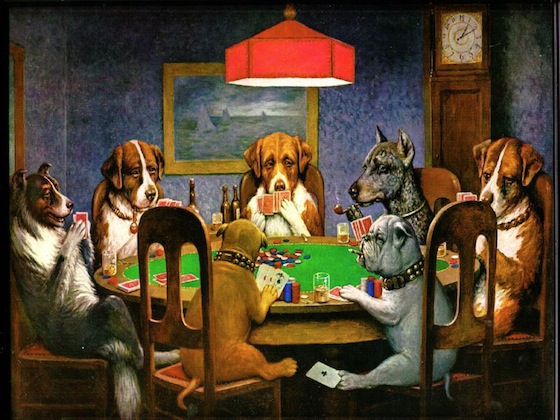
There’s a sucker at every table

If you’re not sure who the sucker is, it’s probably you. That old poker maxim can easily be applied to the game of advertising.  For instance, could your ads be stacking the deck against you? There’s one way to find out.

Let’s say your ads don’t play out as expected. Was it the ad guy? Maybe. The product? Possibly. Most often, though, advertising failures are the result of weak offers; ones that push what you wish customers were thinking instead of speaking to what’s really in their head.

Who are you talking to?

What’s in every customer’s head? The customer, of course. How ads run astray of this fact of human nature traces back to the 1940′s when Rosser Reeves first popularized advertising a brand’s Unique Selling Proposition. The once-holy grail of USP focuses on the product, isolating what’s special, different, and unique about it.

Effective advertising today, instead, starts with customer needs, speaks the customer’s words, and leads to a Unique Buying Proposition: a power offer. To qualify as a powerful offer it must couple a product or service the customer cares about with an incentive of greater than expected value.

Make a powerful offer

Sam Walton built Wal-Mart with powerful offers. He’d look at a product and ask, “at what price could we sell a lot of these?” The rest is history.

It’s not hard. Look at your products. Pick one customers already want. Ask the Sam question: “At what price…..?” Then, promote it with guns blazing. Just make sure you have plenty to sell.

Price is one kind of powerful offer. Remember, the key ingredient in a powerful offer is the customer’s perceived value. That’s why it also works for added services, locations, ease-of-use, or whatever lights a fire for your customer.

Unique Buying Propositions lead to powerful offers

  • How could we package services so we can sell a lot of them?
  • Where could we locate the store to sell to a lot of people?
  • How can we make it easier for customers to buy a lot of these?
  • And, of course, at what price could we sell a lot of these?

Powerful doesn’t mean cheap

Apple products aren’t inexpensive, but their offers must be powerful. Its smartphone marketshare surpassed Nokia. It’s about to eclipse Exxon-Mobile as the most valuable company on earth.  Maybe that’s because Apple asked questions like: “What products would make life easier for a lot of people?” And, “How can we sell a lot of them?  Powerful offers produce profitable results.

The answer is standing in front of you

You see customers every day. Watch them. Study them. The better you understand their UBP the better you’re equipped to make a powerful offer. Otherwise, you’re not buying advertising. You’re paying to hear or see your name. Doesn’t that seem a sucker’s bet?

post

The triangle of combustion: why websites aren’t advertising

Ask any Boy Scout how to start a fire. He’ll tell you it’s a triangle: fuel, oxygen, and heat. Get enough of all three and you get a fire.

There’s a triangle of combustion like that in advertising: message, delivery, and engagement. Getting that triangle right will light a fire under your sales. Message is fuel, delivery is oxygen, and engagement generates heat. Ignition comes at the moment of conversion, when a visitor becomes a customer.

What a website isn’t

You may have a smokin’ hot website. But, your website isn’t advertising. Advertising is intrusive. Advertising intercepts your customers, catches their attention, arouses curiosity, speaks to their desires. Your site doesn’t start that fire. It feeds it.

Yes, your message lives on your site. Yes, your site engages customers. But, you can’t optimize a fire that hasn’t started. That takes advertising.

If your site carries through on the advertising message but isn’t producing, look beyond the site. Look at the advertising itself. A website can’t catch someone’s attention from the side of the road. It’s not going to pop up on the 10pm news. It’s doesn’t ride along in the car.

Optimize with advertising

I ran a campaign for a retail client recently that proved the strength of these three legs. Even though we’d just relaunched their website, not one dime went toward ad words or paid search. Instead, we advertised: tv, radio, banner ads on newspaper and local TV station websites.

But, I left something out. The ads didn’t include their phone number, address or website. Instead, they said, “you can find us.” Upon hearing “you can find us,” people understood that meant, “Google us.”

How did it work?  Traffic went up 13x. Record setting sales weekends—for the tenth year in a row.

Metrics measure combustion

Your website’s metrics have a seductive quality. Tracking visits, page views, bounces is fascinating stuff. It’s also distracting.

Properly applied, metrics measure how well site visitors become customers. They indicate when your triangle generates sales combustion.
What metrics don’t measure is advertising effectiveness. Using web metrics to measure advertising effectiveness is like calculating sales by counting cars in the parking lot.

Help customers connect

Stoking a fire means making it easy for customers to connect the legs of your triangle:

  • Message: Does yours articulate the customer’s felt need?
  • Delivery: Do you reach out and touch new customers with that message?
  • Engagement: Is there a clear destination for the message on your site?

Remember, every tool has its purpose as does each leg of the triangle. Expecting one part to do another leg’s job weakens all three. Giving each appropriate attention will put you on the path to the warm fire of optimized advertising.